
My blog metamorphoses colours from my palette into words, reflecting my creative and spiritual life. Creativity intertwines with spirituality, driving me beyond routine and weaving imagination, emotion, and passion.
Colour is nothing but light
On 5 October, the Nobel Prize in Physiology or Medicine went to three scientists for something called optogenetics. When I read about it, I felt something I can only describe as recognition.
Here is the story, in simple words.
In the early 1990s, a German scientist named Peter Hegemann asked a small question. How does a tiny green alga, just one cell, know where the light is? Put it in a dish of water, shine a lamp on one side, and it swims towards the light.
The answer was a protein in the alga’s eyespot. He and Georg Nagel found that when blue light falls on this protein, a small gate opens and an electrical signal is born. They called it channelrhodopsin.
Then Karl Deisseroth, at Stanford, placed this protein into nerve cells. With a flash of blue light, he could switch a brain cell on. Today, scientists around the world use this method to understand how nerve cells shape our memories, our feelings and our behaviour. Doctors are even exploring it to help restore sight.
Light, it turns out, can speak directly to a neuron.
I am not a scientist. I am not even a formally trained artist. Nobody taught me which colours are allowed to sit next to each other, so I never learnt the rules.
My canvases have always been full of colour. So are my clothes. Colour brightens my world, and I have always felt it carries an energy. When you see a colour, there is something beyond it.
When I talk to young artists, I often hear the same thing. They hesitate to use bright colours. They have been taught a system, and the system tells them to hold back. I understand why the rules exist. But I sometimes wonder what we lose when we learn to be careful with colour before we learn to feel it.
My mentor used to talk about neurons and their power: how everything we remember and feel travels through these tiny cells. I listened, but I held it the way an artist holds an idea. As a feeling, not a fact.
So when I read about this year’s Nobel Prize, I felt a quiet joy. The science does not say that colour changes anyone’s brain. What it shows is simpler and, to me, more beautiful. Life has been answering light for a very long time. A single cell in a pond turns towards it. A neuron can be woken by it.
And colour, in the end, is nothing but light.
Perhaps that is why it has never felt like decoration to me. When a thought you have carried for years meets the work of people who spent decades in a laboratory, it feels less like proof and more like company.
Science asks how light moves us. Art has always simply let it.
To every young artist who is afraid of bright colours: don’t wait for permission. Let the light in.
What does colour do for you?
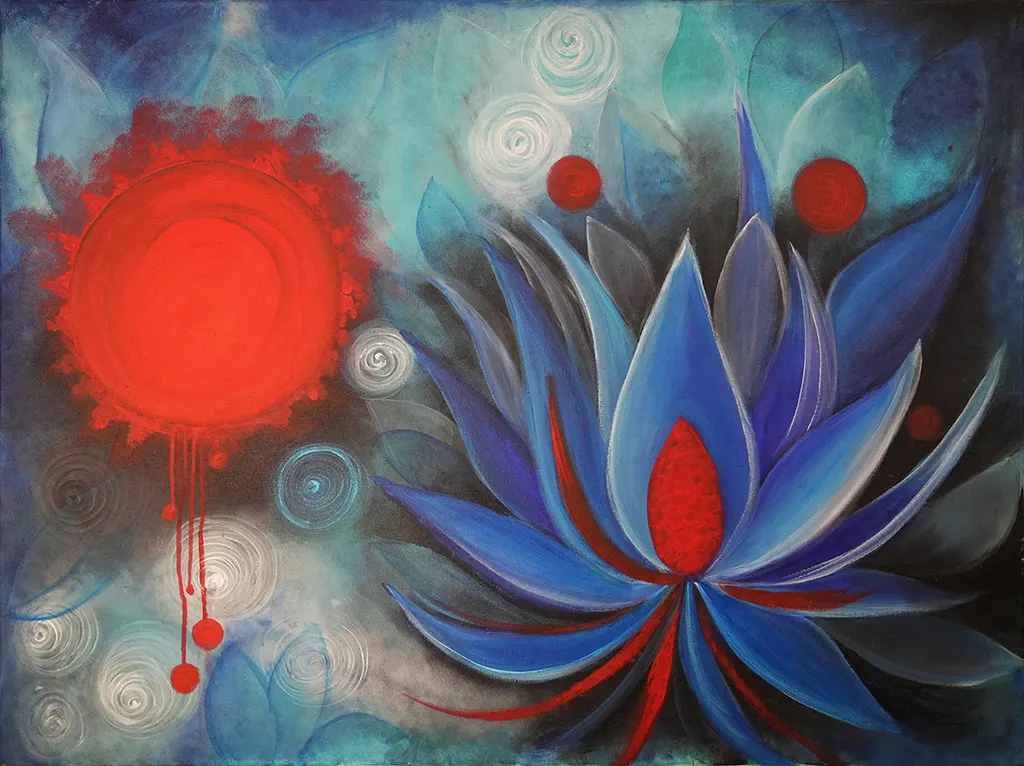
The painting is mine: When the Sun Bloomed, 2024.
Sources
The Nobel Prize: press release, 5 October 2026
The Nobel Prize: popular information on the 2026 prize
Ophthalmology Times: optogenetics and vision restoration
First published in my newsletter The Speaking Canvas on LinkedIn.
Leave a Reply
"I am blessed to be an artist and driven to succeed as an entrepreneur, using the power of my creativity and determination to create meaningful change and inspire others."
Would you like to energize the space around you?
Let's TalkI bring my spiritual and creative quotient, and networking to corporate boardrooms, and facilitate global business breakthroughs with highly nuanced solutions.
The deeper you dwell within to understand oneself taking you to places connecting the divine that heals and rejuvenates.
 SREEBALA INC,
22/27, Alikhan Street, St. Thomas Mount, Chennai - 600 016, India